


This tutorial is for the interface and features of Version 1.1 of DREN-URBA.
With the release of Version 2.0 in November 2015, some features have been modified, as you will see in the corresponding tutorials.
Urban Drainage Systems comprise a number of elements, from the stormwater catching system (drainage inlets) to the pipes and channels that allow the conveying and discharging of the precipitated rainwater to natural and artificial channels, for its free runoff.
Proper design of urban drainage systems will ensure that, for different rainfall frequencies and durations, not only will the property’s integrity be guaranteed, but also the free traffic of vehicles and people during the rainfall occurrence is guaranteed.
The urban drainage design requires issues such as:
- The determination of the maximum stormwater flow that is possible to convey by the road (Streets, Avenues) without exceeding water flood height and spread, usually preset by Urban Drainage Design Standards, according to the importance of such roads.
- Calculation of the Maximum Rainfall Flow, using methods such as the Rational, in which determining parameters such as the Time of Concentration and weighted Runoff Coefficients is needed, according to the land use characteristics in the drainage area affluent to the stormwater collection system as well as the respective sewer network.
- Determining, based on the Maximum Stormwater Flow estimated for each street section, the hydraulic parameters related to its cross section and longitudinal slope, i.e., flood spread, height of water relative to the curb, among others. These values will be compared with the normative parameters so as to establish the need (or not) to use elements for stormwater collection such as drainage inlets.
- In cases where using drainage inlets is required within the urban drainage system, it will be necessary to determine the intercepted stormwater flow by those collection elements as part of the design. This, most often, is an iterative process so as to determine the type of inlet, with the best efficiency for the estimated flow conditions.
- Determining diameters and longitudinal slopes for the storm sewer network system, which is one of the main components in urban drainage systems, as it will be responsible for receiving the flow Intercepted by drainage inlets and lead it to the provided discharge point.
As we see, the design of urban drainage systems involves a series of relatively complex calculations that, in cases where it must be performed manually, may be subject to errors that are difficult to detect without a thorough review of all involved operations.
Even though this manual calculation could be error free, any parameter modification (such as the shift of the drain inlets type) will require the modification of calculations already made, complicating the study of alternatives in the design.
This is the reason we have developed DREN-URBA, the Stormwater Drainage Design Software, so as to allow the designer engineers to easily perform the calculation of all required parameters in the design of urban drainage systems, providing the tools to study different configurations for the superficial drainage system (Inlets design) as well for the Storm Sewer System.
Overall, DREN-URBA calculates, in tabular form, two systems:
The Superficial Urban Drainage System
This is based on “Street’s sections,” for which the user will enter the geometric parameters (such as longitudinal and cross slope, width, etc.), the drainage areas at each street’s margin, with their respective runoff coefficients for use with the rational formula, as well as, if necessary, the storm drainage inlet that will perform the street’s stormwater flow catchment.
DREN-URBA will determine, from the information provided for each street section:
- The Weighted Runoff Coefficient, Time of Concentration, and Rainfall Intensity for the user’s selected Return Period.
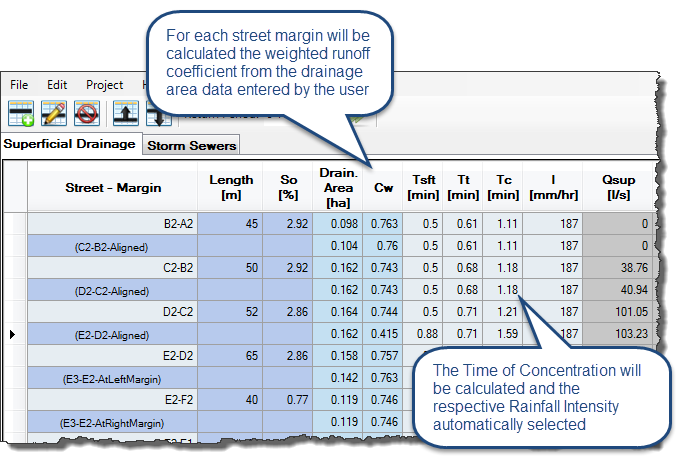
- The Maximum Stormwater flow at the most downstream point of each Street section (and for each margin).

- Street’s Hydraulic Capacity, considering its operation as a triangular section channel (half of the cross section). Additionally, the flood width (spread) and height of water generated in the Street by the maximum stormwater flow are determined. These parameters are what the user will use to establish whether or not to use Drainage Inlets.
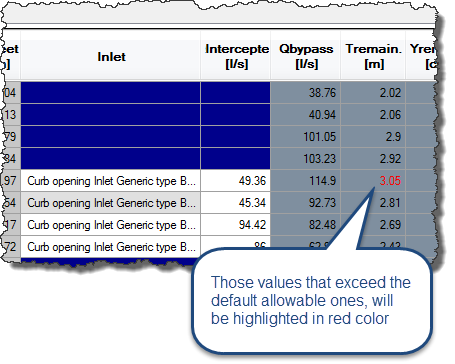
- DREN-URBA also determines, for the type of storm drainage inlet selected by the user at each street’s margin, the intercepted flow, setting the hydraulic parameters associated with the bypass flow (or carryover flow), if applicable:

The Storm Sewer System
Having performed the design of the Superficial Urban Drainage System (Inlets design), the user will be required to establish the Storm Sewer Network needed for the collection of the rainwater captured by the drainage inlets.
In this case, DREN-URBA requires the user to set the geometric properties of the network such as pipe’s lengths, diameters, and invert elevations, among others.
Additionally, based on the configuration given by the Designer Engineer, the drainage inlets that are connected to each sewer section must be entered, so that DREN-URBA performs the calculation of drainage areas affluent to each component of the Storm Sewer Network.
With the provided information, the user will obtain:
- The total Time of Concentration and the design Intensity to be used in each section of sewer pipe, depending on the return period selected by the user.
- Maximum Rainfall Flow associated with each sewer section.
- Sewer pipe hydraulic parameters: Maximum flow (capacity) and Flow Velocities (at full section, Vc, and for the maximum flow, Vr):
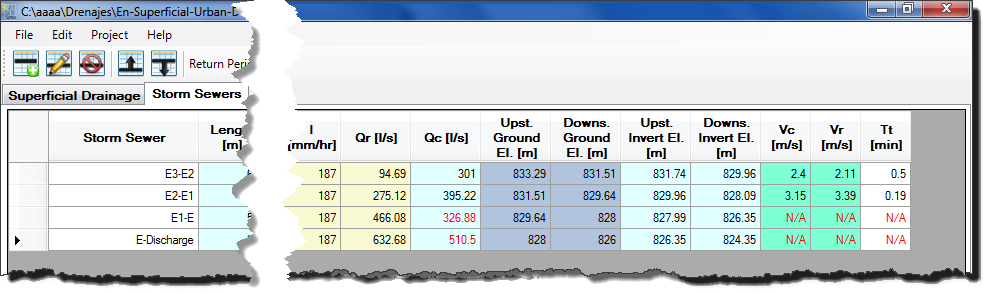
Similar to the case of the Superficial Drainage System, DREN-URBA will warn the user, with red text, about those values that violate any condition. For example, in the figure above, we can see that, in the case of E1-E and E-Discharge sewer pipes, the flow rate at full section, Qc, (capacity of the pipe) is highlighted, so as to indicate it is less than the maximum flow of stormwater associated with the respective sewer pipe.
Thus, we are confident that the best tool for the Design of Urban Drainage Systems is DREN-URBA. What are you waiting to try it for?